

We need leaders who drive at speed. But we train them to hit the brakes.

You can tell when a company has decided it wants leaders who drive change rather than manage it.
The strategy deck starts talking about agility, transformation, and speed. Leadership expectations get rewritten. Competencies are refreshed. Development initiatives appear across the business.
Then time passes.
The leadership team is still managing change beautifully and driving very little of it.
Why?
Driving change is a different operating mode than managing it, and you cannot move a team from one to the other by teaching them about the difference.
A team that manages change moves the work in front of it. When conditions shift, they adjust the plan, escalate the blocker, request the resource, and wait for clarity before acting.
In a stable market with a proven operating model, this is exactly the team you want.
A team that drives change operates differently. When direction is unclear, they treat clarity as something they are responsible for creating. They know which decisions are theirs to make, make them without waiting, and pull the right stakeholders into the room early when alignment is needed.
When tension appears, they address it directly instead of managing around it to preserve smoothness. They are willing to make a reasonable call before certainty arrives because they understand the cost of waiting can exceed the cost of being wrong.
The behaviors that define a driving team get built by driving, not by learning about driving.
This is where most leadership development quietly breaks down.
You can teach frameworks for decision-making, strategic thinking, and productive conflict. The team may leave able to describe the model perfectly, then return to escalating the next difficult decision exactly as before.
The capability does not transfer because the learning environment was never carrying the weight that builds it.
The two types of team are easy to confuse from the outside. Both look busy. Both hit milestones. The difference only shows up in one place: what each team does with the call nobody wants to make.
The difference is not effort or intelligence. It is the operating mode underneath the behavior. Here is where that difference usually shows up:
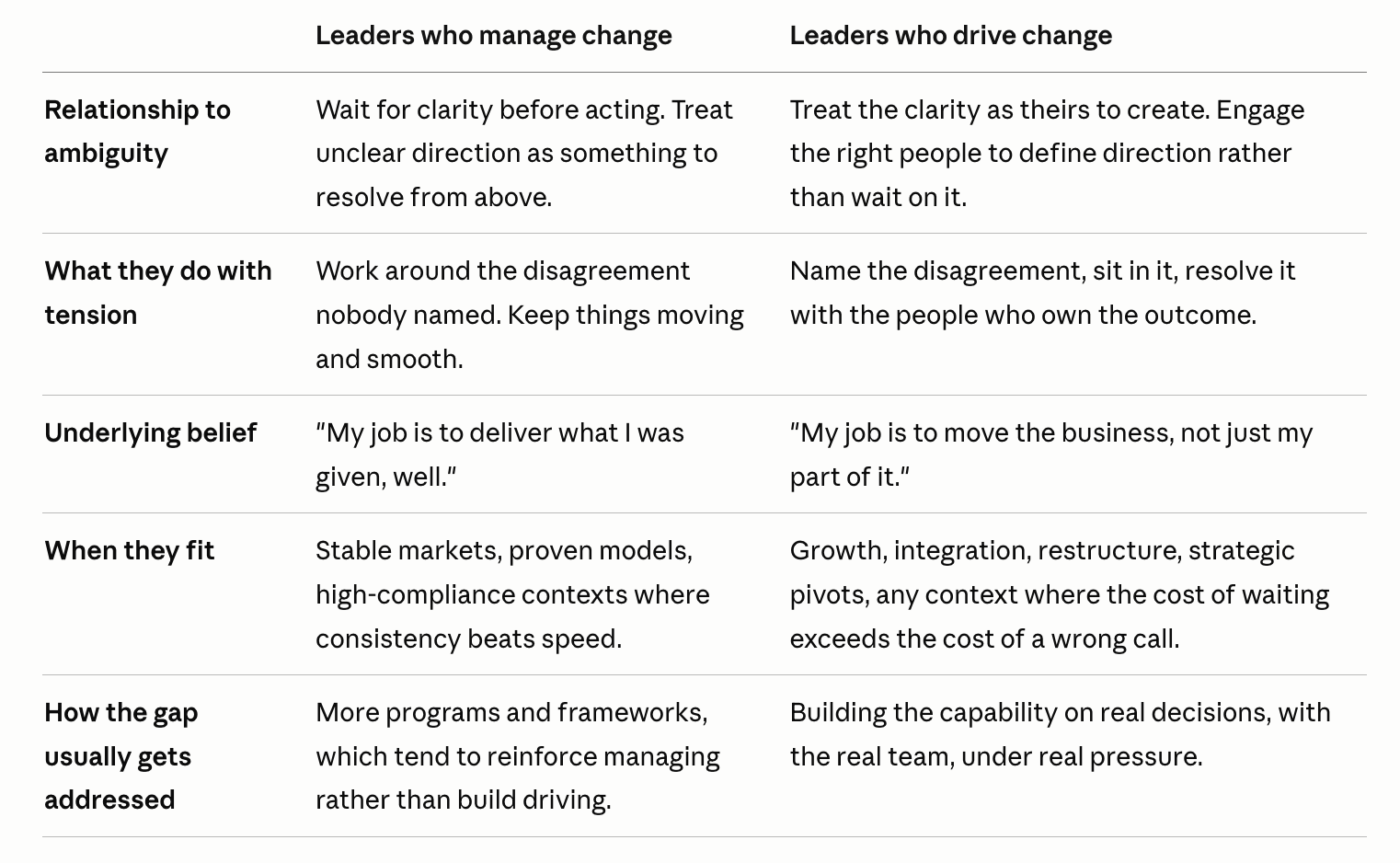
Most organizations say they want the right-hand column while continuing to reinforce the left.
AI is making this gap far more expensive because it has dramatically compressed the pace at which businesses need to sense, decide, and respond. A team that merely manages change used to have time to catch up to the market. That room is disappearing fast.
Most organizations still rely on operating rhythms built for a slower environment: escalations, alignment loops, layered approvals, and leadership development separated from the work itself.
The problem no longer shows up as a soft capability issue. It shows up as missed market position.
This is why we take a different route at Leap Catalyst.
Instead of developing leaders next to the work, we build the capability inside the live strategic challenges they already own. The challenge becomes the development.
That might mean:
a leadership team that has not aligned on a new direction
a priority that repeatedly stalls
a restructure, integration, or market shift still creating friction across the business
The decisions made are real business decisions the organization already needs. The pressure is real. The accountability is real. And because of that, the capability holds.
By the end, the team has not learned about driving change. They have driven one together.
Before you commit to the next program, the question worth answering is whether your current leadership development investment is built to close this gap or quietly widen it.
That is what the Leadership Investment Assessment is for. It scores your development approach across four dimensions and shows you whether it is set up to produce business results or just activity, with a stage result that tells you where to focus first.
Just five minutes, results on the spot: leapcatalyst.co/invest
The mind behind this:
Dorothy Tsui is the Director and Founder of Leap Catalyst. 20+ years as a consultant and coach in people and organization development, after coming up on the business side where result measurement was not optional. She has a sharp eye for the absurd and a low tolerance for fluff. Her clients get straight talk and results they can defend.