
Change-Driving Capability Is Not Just a Leadership Issue. It Is a System Test.

In my last article, I wrote about the difference between leaders who manage change and leaders who drive it.
The point was not that one group is more committed, talented, or courageous. The point was that organizations often say they want leaders who drive change while keeping the conditions that train them to manage it.
That matters more now because leaders are working through overlapping uncertainty: shifting markets, AI disruption, cost pressure, changing employee expectations, and strategies that keep adjusting while the work is already moving.
Uncertainty is not always the problem. Often, it is the condition that reveals the problem.
It reveals what the leadership system is really built to do:
Can leaders create clarity when direction is incomplete?
Can decisions keep moving when the data is imperfect?
Can tension improve judgment, or does the team smooth it over and call that collaboration?
Can real business pressure build capability, or does it simply stretch people thinner?
Capability does not operate in a vacuum
These are not capability questions in the narrow sense of whether leaders have a skill. They are capability-under-condition questions.
The Change-Driving Leadership Assessment looks at four leadership capabilities: creating clarity, sustaining decision momentum, challenging with ownership, and building capability through real work.
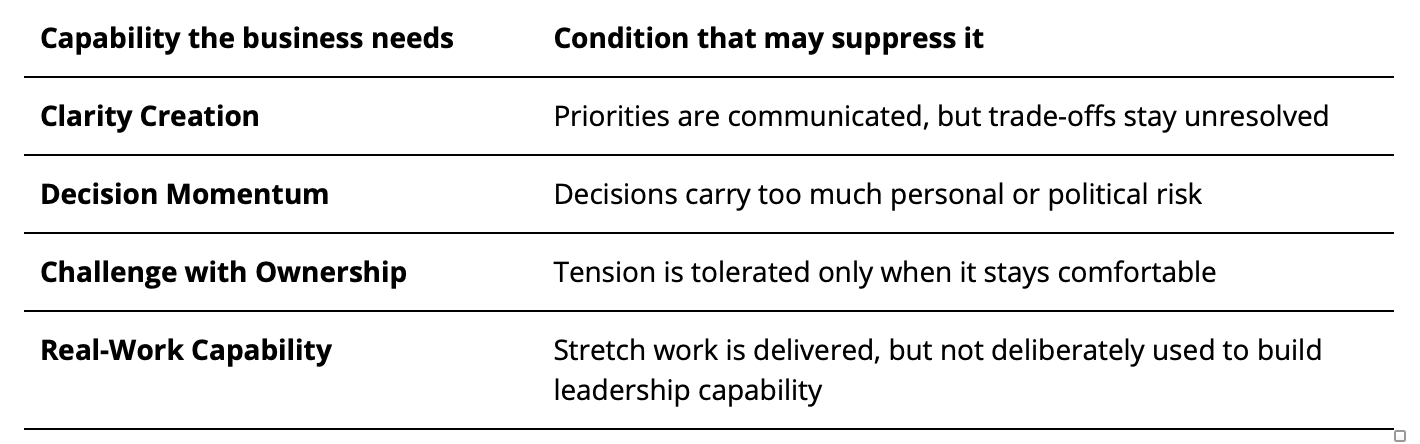
But capability does not operate in a vacuum. It grows or gets suppressed by the conditions around it. Clarity weakens when trade-offs are avoided. Ownership shrinks when difficult calls keep moving upward. Challenge becomes careful and polite when tension is quietly punished.
That is why the assessment does more than identify capability strengths and gaps. It also points to where leadership drag may be blocking the capabilities the business now depends on. It does not just ask whether leaders have the capability. It asks whether the system allows that capability to show up when pressure is real.
Leadership drag is where capability gets blocked
Most organizations know what they want from leaders: speed, accountability, strategic thinking, collaboration, resilience, and the ability to lead through ambiguity. That is usually not the gap.
The gap is between those expectations and the conditions leaders are actually working inside.
Pressure and uncertainty do not create leadership drag. They expose where drag was already there.
In stable conditions, leadership drag can hide inside the system. There is time to clarify, structure to compensate, and senior leaders available to rescue delayed decisions. Under pressure and uncertainty, those buffers disappear. Delayed decisions create more ambiguity. Blurred priorities scatter effort. Avoided tensions become execution issues. Stretch work that does not build capability leaves leaders no stronger for the next challenge.
The problem no longer shows up as a soft capability issue. It shows up as lost momentum, weaker execution, and reduced capacity to respond when the business cannot afford to slow down.
Four places to look first
Leadership drag usually becomes visible in the same four capabilities the assessment measures. The question is whether those capabilities hold when the work gets pressured, unclear, political, or uncomfortable.
1. Clarity Creation
Can leaders create usable direction when the path is unclear?
Most organizations do not suffer from a shortage of communication. They suffer from a shortage of usable clarity. If the choices underneath the message remain unresolved, people stay busy without converting effort into movement.
2. Decision Momentum
Can leaders keep important decisions moving without unnecessary delay?
Delay often looks responsible: another stakeholder conversation, another escalation, another version of the deck. From inside the system, it can look like good governance. From the business, it feels like drag.
3. Challenge with Ownership
Can leaders challenge assumptions directly and stay accountable for what happens next?
Many teams keep difficult conversations professional. That is useful, but it is not the same as handling tension well. The meeting stays smooth, but the problem stays alive.
4. Real-Work Capability
Does leadership capability get stronger through live business challenge?
Stretch work can build capability, but it can also reinforce old habits under more pressure. The work may get done, but the capability does not necessarily grow with it.
The usual response can miss the point
When leadership pressure rises, the instinct is often to add another solution: a resilience workshop, an AI readiness session, a decision-making module, or another offsite on alignment. None of these are automatically wrong. They become the wrong answer when the real issue has not been diagnosed.
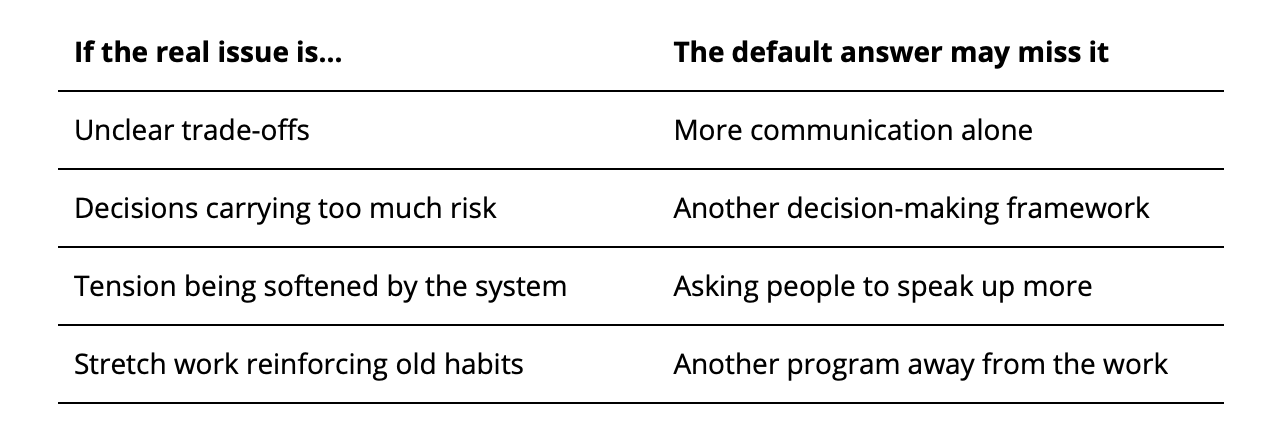
Before choosing the next intervention, the question worth answering is simpler and harder: Where is leadership drag actually showing up, and what is keeping it in place?
What the assessment is designed to reveal
That is what the Change-Driving Leadership Assessment is designed to reveal. It looks at how leadership shows up when priorities are unclear, decisions are difficult, tension is real, and execution cannot wait.
It shows where the four leadership capabilities are strong, where they are inconsistent, and where the system may be creating drag around them.
The point is not to judge whether leaders are good or bad. It is to see whether the leadership system is enabling the capabilities the business now depends on, or quietly suppressing them under pressure.
Take the assessment now and see where leadership drag is slowing movement.
P.S. The bigger question is how capability gets built in the same conditions where leaders are expected to use it. That is what I will take into the next article: why change-driving leadership capability is not built beside the work, but inside it.
The mind behind this:
Dorothy Tsui is the Director and Founder of Leap Catalyst. 20+ years as a consultant and coach in people and organization development, after coming up on the business side where result measurement was not optional. She has a sharp eye for the absurd and a low tolerance for fluff. Her clients get straight talk and results they can defend.