

Can Your Leaders Work the Way Your Strategy Requires?

One of my clients, a global technology company specializing in precision measurement., was repositioning itself to drive growth and stay competitive. The company operated across multiple continents, and changes often overlapped. A team could be redesigning a process and introducing a new tool while customer expectations shifted. By the time it had worked out how to implement one change, the next could already be underway.
The business still had to deliver for customers. Leaders were responsible for moving changes forward, even when the decisions they needed sat in another function. When teams escalated those issues by default, the same people in senior roles ended up fielding problems that the functions involved could often work through together.
Once the strategy changes, where do the decisions go that will make it happen?
Last week I wrote about designing projects that give leaders a chance to practice the capabilities their business needs. This case takes that question into day-to-day work. Leaders have to use those capabilities when a change stalls and teams are already working to deliver on existing commitments.
Why leaders needed each other
Take a redesigned process for handling customer requests. If teams keep using a workaround, Operations can show where the process breaks down and IT can check whether a fix would affect other teams using the same system. If the change affects what the company can deliver, Sales can clarify what has already been promised to customers. Marketing can offer a wider view of what customers are starting to expect, while R&D can explain what the product can support. HR can weigh in where the change requires new skills or a shift in responsibilities.
With those perspectives in the room, the leaders can test an assumption before acting. A problem that looks like resistance to a new process might turn out to be a system constraint. If the fix affects several teams, the leaders can bring forward a recommendation that reflects the trade-offs each team would face.
How the development program translated into action
We built quarterly Action Learning team coaching into the wider leadership development program. Leaders brought unresolved issues from their own areas, and peers from other functions asked questions that challenged how they had framed the problem. The leaders who brought the issue chose what to try. Between sessions, the rest of the program gave leaders opportunities to follow through and examine what happened.
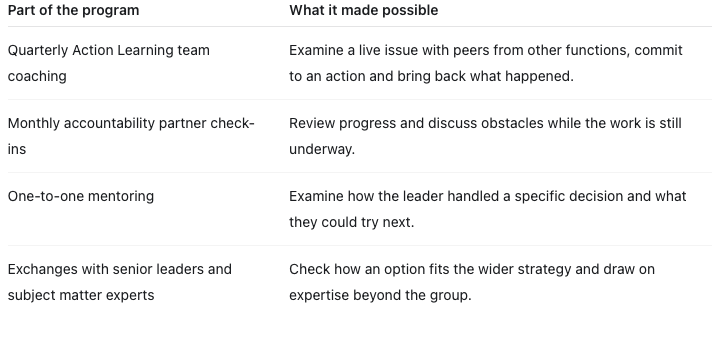

Leaders reported asking more questions in their regular team meetings and giving less direction. They described resolving some issues with their teams that they would previously have escalated. For a business managing overlapping changes, that was a useful sign of application. Leaders could point to decisions that had moved forward with the people closest to the work.
Test one decision with your business sponsor
Choose a growth or change priority already underway. Name a decision it will put in front of your leaders, then work through it with the sponsor.
What should leaders do differently? Identify the functions they need to involve and what each contributes to the decision.
What can they decide? Establish what they can test or commit to themselves and what requires approval.
What would count as evidence? Agree when you’ll review a real decision and look at what moved forward, what the team owned, and what still had to go up the chain.
If you’re planning development around cross-functional leadership, compare the decision you’ve just mapped with the opportunities leaders will have to practice it. That comparison gives the sponsor something specific to change in the program or in how the work is organized.
Bring a decision you need to make
If you’re deciding what to keep, change, or stop in your leadership development plan, bring one current priority to Rethink Leadership: Leadership Development: What Stays, What Goes? Use the conversation to test that priority against what the business now needs and work out what you’d take back to your next planning discussion.
Wednesday, November 25, 12:00 to 1:00 p.m. UK time, on Zoom. Free to attend. Register for Rethink Leadership.
What does your business need its leaders to do differently?
If you’re reviewing a leadership program or planning development around a business priority, let’s examine what leaders need to become capable of doing and how the experience could be designed to build it.
Book a 30-minute conversation with Dorothy.
The mind behind this:
Dorothy Tsui is the Director and Founder of Leap Catalyst. 20+ years as a consultant and coach in people and organization development, after coming up on the business side where result measurement was not optional. She has a sharp eye for the absurd and a low tolerance for fluff. Her clients get straight talk and results they can defend.