

Would You Put This Leadership Program in Next Year’s Plan?

Before confirming another cohort for an established leadership program, I’d want to know what has changed for the business since it was designed.
The program may still be valued. Its content may still be relevant. The question is whether it develops the capability the business will depend on as it grows and changes.
A commercial bank I served had to examine that connection as expectations were changing among both its clients and its workforce.
The bank wanted its commercial teams to sell higher-value products. Clients were increasingly informed and wanted an active role in understanding their options, evaluating recommendations, and making financial decisions. Expectations once associated with premium banking were becoming familiar across other client segments.
Product knowledge remained essential. Commercial teams also needed to use that knowledge in a consultative conversation. They had to understand what mattered to the client, ask questions, and discuss options with someone who wanted to participate in the decision.
That had implications for how their leaders led.
What would prepare the team for a different client conversation?
Leaders were accustomed to setting demanding targets, directing activity, and pushing for sales performance. The bank wanted them to become people developers who could bring out the best in their teams.
A target could establish the result expected. Leaders also needed to develop the judgment and skills people would use to achieve it.
For example, someone might know a product thoroughly and still struggle to explore a client’s priorities before recommending it. Their leader would need to recognize what was happening and coach them through it. Giving further product information would address only part of that development need.
We redesigned and expanded the existing leadership program around this responsibility.
Leaders received structured training and practice in individual and team coaching. Assessments and 360 feedback informed their own development plans. One-to-one and team coaching supported them as they examined their approach and applied what they were developing.
They were expected to coach their own people and teams, with Talent, HR, and other colleagues involved in supporting their development and its application.
Their KPIs included how they supported and developed their teams, together with sales performance.
The bank’s commercial ambition required a change in the client conversation. Its leaders needed to become capable of developing the people having that conversation.
How does coaching connect with commercial performance?
The intended business impact was to strengthen the teams’ ability to sell higher-value products through informed, consultative client conversations.
That gives coaching a specific purpose. A leader can work with someone on how they explore a client’s needs, how they discuss relevant options, or how they respond when a client questions a recommendation. The development plan can identify what that person will practice and what the leader will review with them.
Team coaching provides a way to work through challenges shared across the team and draw on colleagues’ experience.
The review needs to connect what people are practicing with what happens in their work. Did the conversation reveal something about the client’s needs that had previously been missed? Could the team member explain the relevance of an option and give the client room to evaluate it? What did the leader observe that should inform the next coaching conversation?
Commercial results remain part of that review. They also need to be considered with the quality of the client work that produced them.
For anyone using 70/20/10, this is a practical question about the learning that happens through experience. How well are we preparing leaders to support it? Leaders themselves need practice in coaching people through real work, with feedback and support as they develop that ability.
What does this mean for next year’s plan?
In the bank’s case, the review led to a redesign and additions. Changing client expectations gave the program a commercial reason to evolve. The approach connected leaders’ own development with what they were expected to do in their teams and how their performance was assessed.
You can examine that connection in one initiative from your own plan.
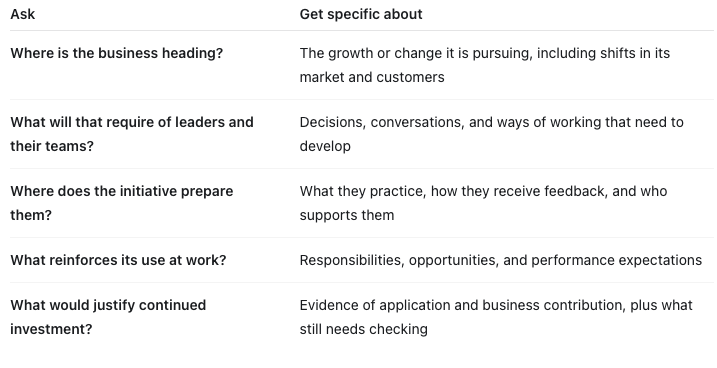
A useful capability may deserve continued investment while the way you develop it needs substantial change. The people attending may need to practice with their own teams. Their leaders may need to become involved. You may find that performance expectations are pulling people back toward familiar habits.
Those findings give you something specific to address before running the program again.
For the bank, the question reached beyond whether its leaders understood coaching. It concerned their ability to develop commercial teams for a changing market.
When you look at next year’s plan, which change in your business needs that level of attention?
Bring an initiative you’re reconsidering
At Rethink Leadership — Leadership Development: What Stays, What Goes?, we’ll draw on research and use a practical framework to examine development priorities as business needs evolve.
Bring an initiative you’re reviewing or a capability your business needs to build. There will be time to compare experiences with peers and work toward a decision you can take back to your organization.
Wednesday, November 25, 2026 · 12–1 p.m. UK · Zoom
Free to attend. Come ready to work together.
Register for Rethink Leadership.
What does your business need its leaders to do differently?
If you’re reviewing a leadership program or planning development around a business priority, let’s examine what leaders need to become capable of doing and how the experience could be designed to build it.
Book a 30-minute conversation with Dorothy.
The mind behind this:
Dorothy Tsui is the Director and Founder of Leap Catalyst. 20+ years as a consultant and coach in people and organization development, after coming up on the business side where result measurement was not optional. She has a sharp eye for the absurd and a low tolerance for fluff. Her clients get straight talk and results they can defend.