

A Critical Challenge Was Resolved. That Does NOT Mean Leadership Capability Got Stronger.

This is the final piece in a three-part series on change-driving leadership. The first two pieces argued that many organizations say they want leaders who drive change, while still training and reinforcing them to manage it (part 1). They also made the case that change-driving capability is a system issue, not only a personal leadership issue (part 2).
This final piece looks at the build question:
If change-driving capability is not built beside the work, what does it take to build it inside the work?
The answer is not to hand senior leaders more real work. They already have it.
Senior leaders are already carrying growth pressure, shifting priorities, stakeholder complexity, delayed decisions, market uncertainty, and work that will not wait for everyone to feel ready. The real question is whether that work is changing how they operate, or whether it is reinforcing the same habits that make the next challenge just as heavy as the last one.
A project can succeed for reasons that have little to do with stronger leadership capability: favorable timing, senior rescue, or a few capable people carrying more than the system should have allowed.
Good outcomes do not prove the leadership system got stronger. They only prove the outcome happened.
That distinction matters because organizations often treat delivery as evidence of capability. Sometimes it is. Often, the result tells you very little about whether leaders are now better able to create clarity, make decisions, challenge assumptions, and carry ownership through execution.
If those ways of operating have not changed, the business has finished the project without building anything that survives it.
That is the missed opportunity.
What organizations misread
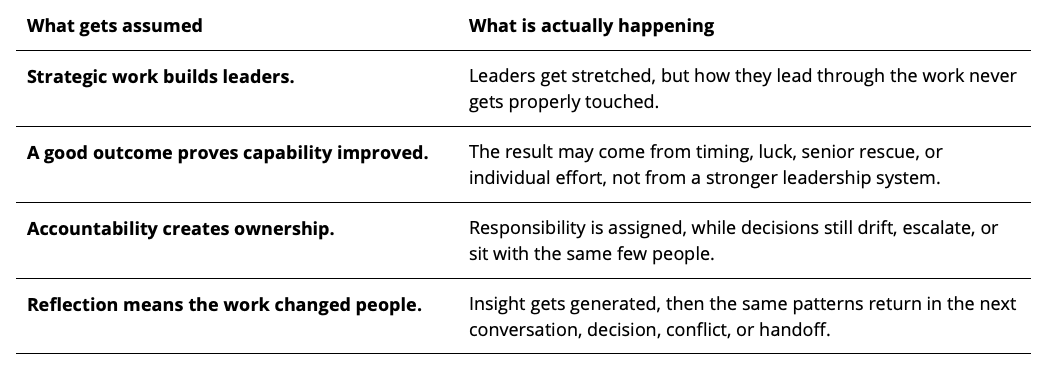
Organizations often assume serious work develops leaders because the work is hard, visible, and important. The assumption sounds reasonable until you look at what is actually happening inside the work.
A leader can be stretched by a strategic project and still lead through the same habits: delayed trade-offs, softened challenge, upward escalation, vague ownership, or a preference for keeping everyone comfortable until the work becomes harder to recover. A good result can hide all of that. So can a thoughtful debrief, especially when the conversation produces insight but does not alter the next meeting, decision, conflict, handoff, or execution rhythm.
The issue is not a lack of serious assignments. It is the lack of discipline around what those assignments are supposed to change in how leadership operates.
The cost is not simply poor leadership development, because that sounds too harmless for what is really happening. It is wasted business pressure.
Organizations already hold some of the strongest raw material for building leadership capability: live work, real stakeholders, visible trade-offs, decisions that cost something, and consequences that cannot be simulated. Used carelessly, that pressure can produce delivery without stronger judgment, effort without stronger capability, and a leadership lesson with no clear connection to what happens next quarter.
That is too expensive to keep treating as incidental.
The fix is sharper design, not more activity
If live work is going to build change-driving capability, it has to change how leaders operate while the business issue is still active. Not afterward, when the pressure has passed and everyone has a cleaner story about what they learned.
This does not turn every project into a training exercise. It means using the work with more discipline. The leadership pattern has to become visible while it is shaping the outcome. The drag has to be named while it is still slowing the work down. Decisions and trade-offs have to be worked through while they still affect the result. Ownership has to become clear enough that execution no longer depends on the same old escalation routes.
The hard question is causation. Handling a challenging project does not automatically mean capability improved. The business needs to know what changed in how leaders worked, and what that change actually did to performance and result.
Three questions cut through the noise:
What changed in how leaders created clarity, made decisions, challenged assumptions, or owned execution?
How did that change affect speed, rework, risk, escalation, or commitment?
Can the team carry that stronger way of operating into the next priority, or was this just another useful experience with no operating consequence?
That is the difference between a leadership lesson and capability the business can use.
Four capabilities, built inside the work
This is where the four change-driving capabilities stop being workshop language and become operating requirements. They matter only if they change how the business works under pressure.
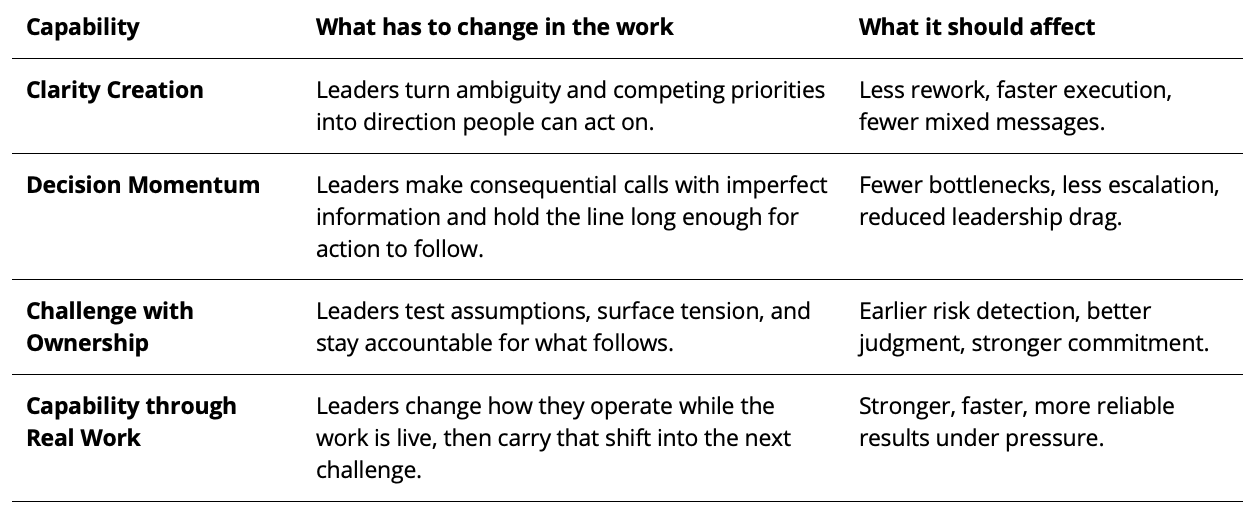
The last capability is the point of the whole argument.
A successful project matters, and a useful debrief has its place. But the business still needs a harder answer: can this team now produce results under pressure without relying on the same rescue patterns, delays, and workarounds?
That is where leadership development has to get harder-edged. The business does not need another experience that people can appreciate but cannot connect to results. It needs leadership capability that changes how work gets led when the stakes are live.
What this means for the work
Leadership capability is not something leaders build somewhere else and bring back to the job later. Programs, tools, and frameworks can support the work, but they remain outside the real issue if they do not change how leaders operate where results are actually made.
This is how Leap Catalyst works with leadership teams.
We start with the live business challenge because that is where the leadership pattern shows up. We use the work to change how leaders create clarity, make decisions, challenge assumptions, and carry ownership while the decisions and trade-offs are still active. The goal is not a good session. It is stronger progress on the work itself, and a leadership team that is more capable the next time it matters.
If you are not sure where the drag is sitting in your team, start with the Change-Driving Leadership Assessment. It gives you a quick read on where change-driving capability is getting blocked.
If you already know the priority, the team, and the challenge, book a direct conversation.
The mind behind this:
Dorothy Tsui is the Director and Founder of Leap Catalyst. 20+ years as a consultant and coach in people and organization development, after coming up on the business side where result measurement was not optional. She has a sharp eye for the absurd and a low tolerance for fluff. Her clients get straight talk and results they can defend.