

What Is the Leadership Program Actually Preparing Leaders For?

The leadership program is back in next year’s budget. Feedback was positive, another cohort is waiting, and the delivery arrangements are familiar.
Planning turns to nominations and content updates. The original purpose receives less attention because it was agreed some time ago.
For the person commissioning it, reopening that discussion could mean questioning work the team is proud of or challenging a senior sponsor who expects the program to continue. With a busy delivery calendar, there are understandable reasons to leave it alone.
But if the business strategy has changed, another successful cohort may leave an important development need unanswered.
What will leaders need to do under the new strategy that the current program gives them little opportunity to practice?
Imagine: The growth plan now depends on different decisions
Consider an established business shifting its growth strategy toward larger contracts with existing customers. Winning more of that work requires several parts of the organization to develop a proposal together, often before the customer has settled on a scope.
Senior leaders may have built their careers running successful functions or business units. They now need to evaluate opportunities whose value and delivery requirements extend beyond their own area.
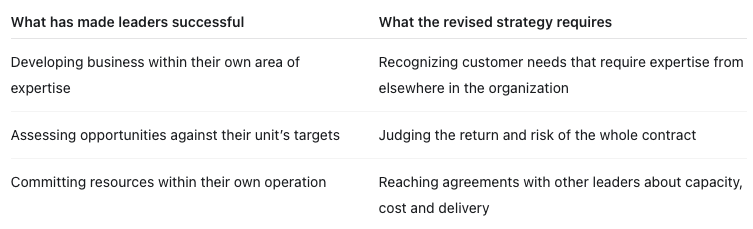
The implications become clear when a promising customer opportunity needs a substantial commitment from several teams. A proposal that looks attractive to one unit may depend on capacity another has already committed elsewhere.
The leaders involved must investigate the opportunity together and reach a recommendation the business can deliver profitably. Being an effective advocate for one’s own unit provides only partial preparation for that judgment.
Explaining the strategy is only the beginning
The leadership program may already include a presentation on the revised growth strategy. Its cases and development assignments could still allow participants to work mainly within their own functions.
They could complete the program successfully without demonstrating how they would handle a shared commercial decision.
A review could introduce an assignment based on an actual customer opportunity. Participants would investigate the need and develop a recommendation for an executive sponsor. Team coaching could examine their reasoning, especially when an attractive proposal creates costs or risks elsewhere in the business.
The sponsor’s feedback would test the commercial quality of the recommendation. It could also reveal where participants need further experience before taking on similar decisions independently.
That is a specific development requirement the program can address.
Be clear about what development can achieve
Some obstacles will require action beyond the program. If leaders are rewarded entirely for their own unit’s revenue, working together may carry a personal cost. Unclear authority over shared resources can also prevent a capable team from making progress.
These conditions belong in the commissioning discussion because they affect whether the learning can be applied. Business sponsors need to establish what participants will be authorized to do and how disagreements will be resolved.
Otherwise, a cross-functional assignment could produce a polished recommendation that the organization has no practical way to act on.
Why reopen the plan now?
If next year’s growth depends on larger, more complex customer contracts, waiting until those opportunities arrive leaves leaders learning through decisions that already carry commercial consequences.
During planning, there is still time to select suitable assignments and secure sponsor involvement. Development can be scheduled before leaders are expected to make the decisions independently.
Once budgets and participant places are committed, changing direction becomes harder. The conversation can narrow to what fits the existing program rather than what the strategy requires.
Before approving another cohort, the review needs to establish:
Which decisions will become more important under the business strategy?
Where do leaders lack relevant experience, and what evidence from their current work points to those gaps?
How will the proposed development provide practice and feedback before those gaps become costly?
The existing program may remain a sound investment. Where the review reveals a mismatch, a focused redesign could make it substantially more useful.
Good feedback gives a reason to value the work already done. Funding another year requires a current judgment about what leaders need to be ready for.
Rethink Leadership | November 25, 2026
A facilitated conversation for people shaping how their organizations develop leaders and teams.
Bring a development priority or an existing program to review against changing business needs. We’ll introduce a few ideas and draw on participants’ experience to examine the decisions ahead.
Free to attend. No sales pitch. Come ready to work together and put the insights to work.
[See the session and register →]
The mind behind this:
Dorothy Tsui is the Director and Founder of Leap Catalyst. 20+ years as a consultant and coach in people and organization development, after coming up on the business side where result measurement was not optional. She has a sharp eye for the absurd and a low tolerance for fluff. Her clients get straight talk and results they can defend.