
Your Leadership Program Has a Project. What Is It Really Developing?

A business wants its leaders to work across functions because its growth plans depend on better coordination. Its leadership program includes a cross-functional project, giving participants an opportunity to practice.
The team divides the assignment according to each person’s expertise, completes the separate pieces and brings them together for the final presentation. The recommendation may be useful. Yet the participants may have had little reason to work through conflicting priorities or make a shared decision.
Those were the capabilities the business needed them to develop.
This is the question I bring to leadership development: what will leaders actually have to practice to complete the work? If they can succeed using the same approach they already rely on, we need to examine how much development the project is likely to produce.
A project can produce a good result while reinforcing the habits the organization needs its leaders to change.
Leaders are resourceful. When a deadline approaches, familiar ways of getting things done are attractive. The development design needs to account for that pressure.
Reverse engineering from what the business needs
I approach the design through reverse engineering: start with what the business needs to become capable of doing, then work back to what leaders must practice.
For a business pursuing growth across markets, “better collaboration” is too broad. The requirement might be to coordinate resources across country boundaries so the business can serve shared clients. Leaders would need to understand competing local priorities and reach agreements they can act on together.
That gives us something more specific to design for than putting people from different markets into the same project team.
A brief distinction between skills, competencies and capability is useful here. Organizations use these terms differently; these are working definitions for this discussion.
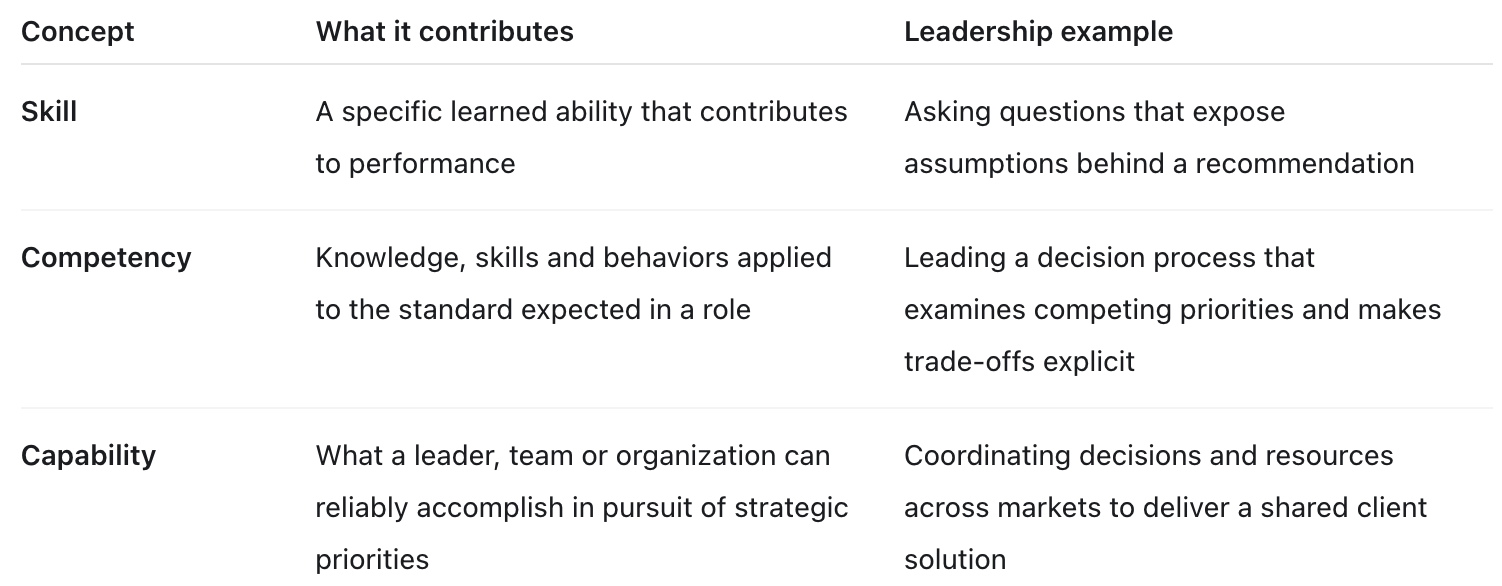
From individual skills to what the business needs its leaders to accomplish.
A leader may know how to ask a good question. We need to see whether they use that skill when a colleague challenges their position, and whether it enables the team to reach a better understanding of the decision in front of them.
The responsibility must fit their authority. An executive may need to approve an investment or make a decision affecting several business units. Participants can still be expected to investigate options and work through disagreements before bringing forward a recommendation. We should be clear about which decisions they own and where sponsor approval is required.
What happens between the project milestones?
One client I served was a global commercial real estate services firm developing high-potential senior leaders across regional operations. Participants were commercially experienced, with established expertise in their country markets and business lines. The program required them to work beyond those boundaries on strategic priorities such as operational performance and cross-business collaboration.
Over six months, teams worked with executive sponsors and progressed from defining their challenge to testing options and presenting recommendations to senior executives.
I provided Action Learning team coaching at the project milestones. There are different approaches to Action Learning; in the approach I use, participants work through the challenge by questioning one another, while the coach draws attention to opportunities to learn from how the team is working.
During the sessions, I made room for the team to reflect on how they were working together. I asked questions so participants could share what they noticed and consider how their approach was affecting their progress. The team decided what, if anything, to change. Participants also gave one another feedback on how they used their identified strengths and committed to actions before the next session.
Working at successive milestones meant we could examine how the teams developed their recommendations while there was still time to adjust their approach. Feedback wasn’t postponed until the work was finished.
This is where a project assignment alone can fall short. People can spend months working together without examining whether they’re listening to one another or simply waiting to present their own view.
In my team coaching practice, I may pause a discussion and ask the team to assess how effectively it’s working. The team considers what needs to change and decides how to proceed. I don’t resolve the issue for them. They need to practice recognizing what the situation requires and adjusting their approach themselves.
Individual development goals become specific too. If someone is practicing listening, I’d want feedback from an actual exchange. Did their next question build on what a colleague said, or did they return to the point they wanted to make? They can use that feedback immediately, in the work still in front of them.
The business has to take the work seriously
The opposite problem is a project with so little consequence that participants can treat it as a presentation exercise.
I discuss this with clients at the outset. If the organization doesn’t expect to use the work, why should participants treat the challenge with the seriousness we expect? A proposal can be an appropriate deliverable, but it needs a business owner who will examine it and decide what happens next.
The design also has to be workable. Leaders need access to relevant people and enough time to investigate the issue. Some groups need preparation in questioning before team coaching sessions can be productive. Those requirements belong in the conversation with sponsors before we launch.
When reviewing an existing program, I’d examine where participants can bypass the intended practice. If collaboration is the goal, can they finish through separate individual contributions? If judgment is the goal, are they expected to evaluate options before seeking approval?
The final presentation tells us what the team produced. To judge the development, we also need evidence of how leaders approached the work and what they became more able to do. Otherwise, we may be investing in an experience that leaves the business dependent on the same habits it wanted to change.
What does your business need its leaders to do differently?
If you’re reviewing a leadership program or planning development around a business priority, let’s examine what leaders need to become capable of doing and how the experience could be designed to build it.
Book a 30-minute conversation with Dorothy.
Rethink Leadership | November 25, 2026
A facilitated conversation for people shaping how their organizations develop leaders and teams.
Bring a development priority or an existing program to review against changing business needs. We’ll introduce a few ideas and draw on participants’ experience to examine the decisions ahead.
Free to attend. No sales pitch. Come ready to work together and put the insights to work.
[See the session and register →]
The mind behind this:
Dorothy Tsui is the Director and Founder of Leap Catalyst. 20+ years as a consultant and coach in people and organization development, after coming up on the business side where result measurement was not optional. She has a sharp eye for the absurd and a low tolerance for fluff. Her clients get straight talk and results they can defend.